
Why Do Basements Require Special Heating?
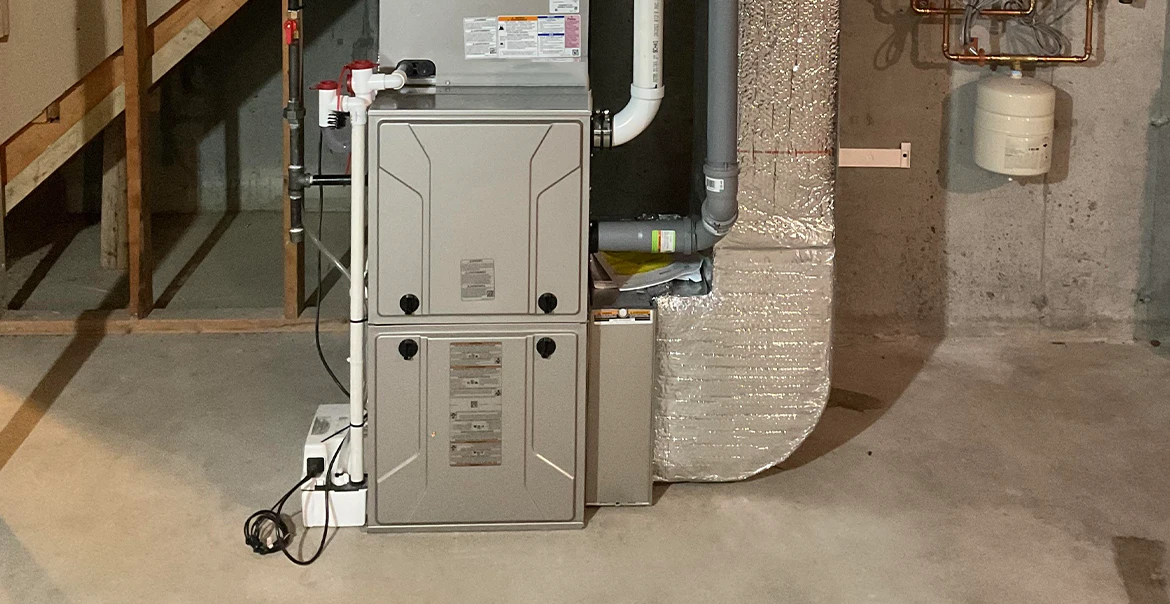
Walk into most basements on a cold morning and the temperature difference hits immediately. That is not just perception. Below-grade construction creates three real, physics-driven problems that any heating plan needs to account for.
Concrete pulls heat out of the room continuously. Foundation walls are in direct contact with the earth, which acts as a massive heat sink. Even when the air temperature is technically comfortable, cold walls and floors radiate that chill back into the space, making a room that reads 68°F on a thermostat feel noticeably cooler.
Higher humidity makes cool air feel even colder. Moisture migrates through concrete and soil, keeping basement humidity elevated. Damp air at 65°F can feel several degrees colder than dry air at the same temperature. It also creates the musty quality that can make basements feel unwelcoming even when the heat is running.
Missing or insufficient insulation lets warm air escape fast. Rim joists, exposed foundation walls, and uninsulated floors are common in older basements. Warm air escapes through those gaps, leaving uneven temperatures and higher energy bills in its wake.
The fix starts before any equipment gets selected: seal air leaks, insulate exterior walls and rim joists, and address moisture. Heating a damp, leaky basement will cost more and feel worse regardless of what system you install.
How to Choose the Right Basement Heating System?
Picking the right setup comes down to three questions: How do you use the space? What does your existing system look like? And how much does long-term efficiency matter?
Usage drives the equipment choice. A basement gym used every morning needs consistent, reliable heat. A storage area needs just enough warmth to protect pipes and airflow to manage humidity. A fully finished in-law suite needs the same comfort standard as any bedroom in the house.
Existing infrastructure matters. Does your furnace or heat pump have spare capacity? Is there ductwork anywhere near the basement? Would independent temperature control for the basement make the upstairs more comfortable too? These are the questions worth answering before committing to any solution.
Long-term operating costs beat upfront price every time. Portable electric heaters look affordable at purchase but are among the most expensive ways to heat square footage over a full winter. ENERGY STAR®-rated systems with smart controls might cost more upfront, but consistently pay back with their efficiency compared to portable electric heaters. Look at AFUE ratings for furnaces and HSPF/SEER ratings for heat pumps and mini-splits when comparing options.
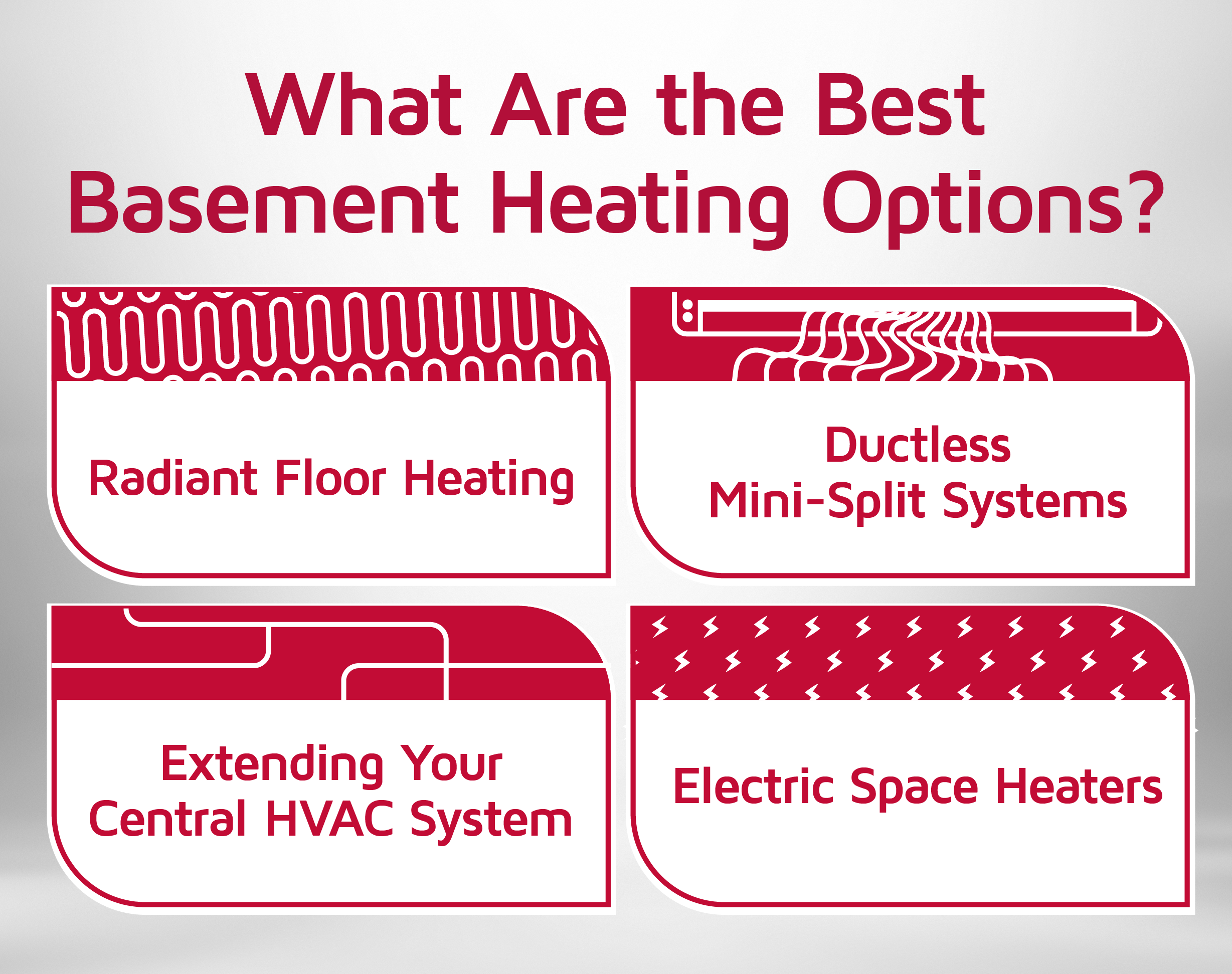
What Are the Best Basement Heating Options?
Radiant Floor Heating
Radiant floor systems heat from the ground up, either by circulating warm water through tubing embedded beneath the floor (hydronic) or by running electric heating elements under the surface. The result is steady, even warmth that spreads across the entire room without blowing air.
This approach is especially effective in basements where cold floors are one of the primary comfort complaints. Hydronic radiant systems like boilers circulate hot water through a home, delivering consistent warmth at floor level where it matters most.
Pros: Even heat distribution; warm underfoot on tile or concrete; completely concealed with no visible equipment; silent operation
Cons: Higher upfront installation investment; ideally planned during construction or major renovation; difficult to retrofit once floors are finished; no air circulation
Best for: Finished basements used long term, including home offices, media rooms, and guest suites.
Ductless Mini-Split Systems
Ductless mini-splits consist of an indoor air handler unit, such as a wall or ceiling mount unit, paired with an outdoor unit connected by refrigerant lines. They heat and cool independently of your home's central system, which makes them one of the most flexible options for a basement that has no existing duct access.
Because each unit operates on its own, the basement can be set to a completely different temperature than the rest of the house, reducing strain on your main HVAC equipment and giving you precise control over a space that may be used on a completely different schedule. Many mini-split models deliver HSPF ratings that significantly outperform standard electric heating.
Pros: No ductwork required; high efficiency; independent heating and cooling year-round; ideal when basement usage patterns differ from the floors above
Cons: Indoor unit can be visible in the finished space; requires professional installation and outdoor unit placement
Best for: Basements without duct access, spaces used frequently throughout the year, or homeowners who want zone-level control without touching their main system.
Extending Your Central HVAC System
If your furnace or heat pump has the capacity to handle additional square footage, extending ductwork into the basement is a practical and integrated solution. Done right, it makes the basement feel like a seamless part of the main home rather than an afterthought.
The key is design. Ductwork must be sized and routed to ensure proper airflow to every room in the basement, not just the space closest to the main trunk line.
Pros: Fully integrated with the home's central system; supports single or multi-zone thermostat control; no additional visible equipment in finished rooms
Cons: Requires available system capacity; must be engineered carefully to avoid airflow and noise issues; zoning is often recommended to prevent overheating upper floors
Electric Space Heaters
Portable electric heaters are useful for occasional, supplemental, or spot heating. They are not a substitute for a permanent system in any basement that sees regular use.
Pros: Low purchase price; immediate setup with no installation
Cons: Higher operating cost per BTU compared to gas-fired equipment or high-efficiency heat pumps; limited to warming the immediate area; safety risks if placed near combustibles or on overloaded circuits
How to Heat a Finished vs Unfinished Basement?
The right heating strategy depends significantly on what the space actually is.
Finished basements function as a living space and should be treated accordingly. If people sleep, work, or spend meaningful time there, comfort expectations should match the rest of the house. Radiant floors, ductless mini-splits, and properly designed duct extensions are all strong options here. A smart thermostat with zone-specific scheduling allows you to run the basement at a comfortable temperature during occupied hours and dial it back automatically when the space is empty, saving energy without sacrificing comfort.
Unfinished basements serve a different purpose. The goal shifts from active comfort to protection and moisture management. Maintaining a base temperature that prevents frozen pipes and controls humidity is usually sufficient. A modest duct extension or a ductless mini-split set to a lower setpoint can accomplish this without the investment of a full comfort system. Prioritize insulating rim joists and sealing the building envelope first, because those improvements make even minimal heating equipment significantly more effective.
The critical mistake is applying the same solution to both scenarios. Over-investing in an unfinished basement or under-investing in a finished one creates either wasted spend or a space people avoid in winter.
How Zoning Helps with Basement Heating?
Before selecting specific equipment, it helps to understand what zoning means and why it matters in a basement context. Zoning divides a home into separate areas, each managed by its own temperature setpoint and schedule. The basement becomes its own zone, independent of the floors above it.
The Lennox Smart Zoning System supports up to four independent zones, allowing you to heat or cool the basement separately from the rest of the house, direct conditioned air only where it is needed, and reduce strain on your main HVAC equipment by not conditioning the entire home to satisfy one zone. Pairing zoning with a Lennox smart thermostat and Lennox Smart Room Sensors gives you accurate, room-level temperature data and remote control via the Lennox mobile app.
How to Make Basement Heating More Efficient?
Even the right heating system underperforms when the space is working against it. These improvements directly impact how well any basement heating setup operates and how much it costs to run month-to-month.
Insulate walls and floors thoroughly. Basement walls that share contact with the earth are constant sources of heat loss, especially in older homes where insulation was minimal or skipped entirely. Rigid foam board on exterior walls significantly cuts that thermal transfer, and adding insulated underlayment beneath new flooring does double duty by warming the surface and reducing heat loss through the slab. Both upgrades make your heating equipment work less to maintain a set temperature, which translates directly to lower energy bills.
Seal every gap before conditioning the space. Heated air finds the path of least resistance, and in most basements, that means escaping through gaps around windows, doors, sill plates, and wherever ductwork or pipes penetrate the framing. Caulk and weatherstripping handle the smaller openings, while mastic sealant or foil tape should be applied to metal duct joints to stop conditioned air from leaking before it ever reaches the room. A well-sealed basement holds temperature longer, reduces how often your system cycles on, and puts less wear on the equipment overall.
What are Common Basement Heating Mistakes?
Skipping insulation and moisture control. No heating system performs well in a wet, drafty space. Fix the building envelope before or alongside any equipment upgrade.
Choosing the wrong system size. Undersized equipment runs constantly without reaching the setpoint. Oversized equipment short-cycles and wears out faster. A professional load calculation removes the guesswork.
Leaning on portable heaters long term. They work in a pinch but cost more to operate over a full season and cannot deliver even, whole-room comfort.
Ignoring long-term energy costs. The unit with the lowest purchase price is often the most expensive to run over its lifetime. Efficiency ratings and smart controls are where the real savings live.
When Should You Call an HVAC Professional?
Reach out to a local Lennox dealer when:
Rooms never reach the set temperature, or your basement stays cold and clammy despite running heat. This often points to a duct design issue, a capacity gap, or a zoning problem.
Your energy bills are climbing with no improvement in comfort. If you are spending more but feeling less, your system, ductwork, or controls may need reconfiguration.
You are planning a basement renovation. The best time to plan radiant floors, ductless unit placement, zoning, and thermostat locations is before walls and ceilings are closed.
An authorized Lennox dealer can evaluate and recommend the best option to heat your space, whether it’s a mini-split, radiant in-floor heating, or extending your current system.
Ready to Transform Your Basement?
Choosing the right basement heating system comes down to how you use the space, what your existing setup can support, and how much long-term efficiency matters to you. Whether you are finishing a basement for the first time or upgrading an underperforming setup, Lennox has the systems, controls, and expertise to get it right. Find a Lennox dealer near you to schedule an evaluation and get a heating solution built for your specific space.
We’re here to help make home comfort solutions a little clearer and a lot less stressful.
No Worries. It’s a Lennox.™