
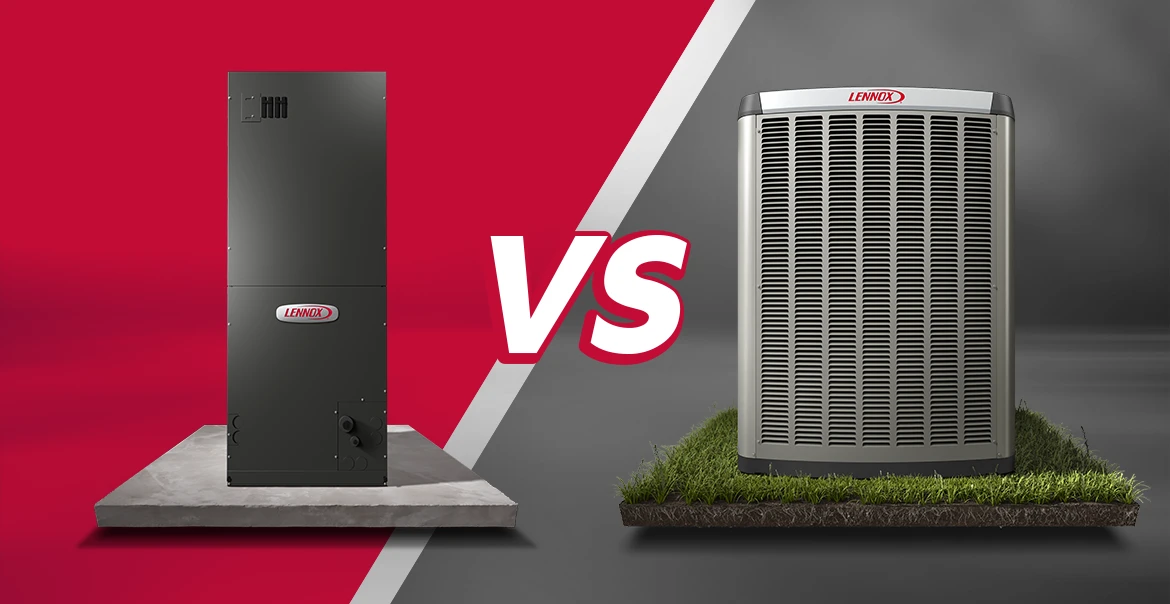
Two Parts of the Same System
Most homeowners know they have a heating and cooling system. Fewer know exactly what that system is made of. When a technician shows up and starts referring to your "air handler" and "condenser" or "heat pump", it can leave you wondering which one matters more or whether you even need both. The answer is that they both matter, and they cannot operate without each other.
What Is an Air Handler?
Think of the air handler as the interior workhorse of your HVAC setup. Installed inside your home, typically in a utility closet, basement, attic, or garage, its entire purpose is to keep conditioned air circulating through your ductwork whenever the system is running, whether that is during a cooling cycle in July or a heating cycle in January.
An air handler does not produce heat on its own, but instead relies entirely on the system’s refrigerant cycle to condition the air it pushes through your home. During cooling, it draws warm indoor air across its evaporator coil, where refrigerant strips out the heat, and then sends the now-cooled air back through your vents. During heating with a heat pump, that same process runs in the opposite direction. The air handler is the delivery mechanism for whatever your system has already conditioned.
Key Components of an Air Handler
The three components that define air handler performance are the blower motor, the evaporator coil, and the air filter.
The blower motor is what physically drives air through your ductwork. Its health directly determines how well your system distributes conditioned air across every room in your house.
The evaporator coil sits at the heart of the heat exchange process inside the air handler. Warm indoor air passes over it, refrigerant absorbs the heat, and cooled air moves into your living spaces.
The air filter rounds out the trio, catching dust, pet dander, and airborne particles before they coat the evaporator coil or recirculate through your home.
What Is a Condenser?
If the air handler handles the indoor side of the equation, the condenser unit handles everything that happens outside your home. Mounted on a concrete pad, rooftop, or side yard, the condenser is engineered to dump the heat that the refrigerant has pulled from inside your home into the outdoor air, or in a heat pump system, to pull heat from outside air and send it indoors.
The condenser cabinet is purpose-built for outdoor exposure, running year-round in conditions that range from freezing temperatures to direct summer sun. Inside that cabinet, three core components manage the heat-transfer process: the compressor, the condenser coil, and the condenser fan.
Key Components of a Condenser Unit
The compressor is the engine driving the refrigerant through the entire system. It pressurizes the refrigerant to elevate its temperature, making it possible to transfer heat efficiently to the outdoor air.
The condenser coil is the surface across which heat is transferred from the refrigerant to the surrounding air.
The condenser fan completes the loop by drawing outdoor air across the coil surface, carrying heat away from the refrigerant and out into the environment.
How Air Handlers and Condensers Work Together ?
The air handler and condenser unit connect through a pair of refrigerant lines that run between the two units, forming one continuous loop. Every cooling cycle follows the same sequence: warm indoor air passes over the evaporator coil inside the air handler, refrigerant absorbs that heat, the blower motor pushes the cooled air back through the ductwork into your home, and the heat-laden refrigerant travels outside to the condenser unit. There, the compressor raises the refrigerant's pressure and temperature, the condenser fan moves outdoor air across the coil, and the absorbed heat dissipates into the outside air. The refrigerant then cycles back indoors, and the process starts again.
This partnership plays out a little differently depending on the type of system installed. In a split air conditioning system, the air handler and condenser work strictly in one direction, moving heat out of your home to keep indoor temperatures down. In a heat pump system, those same two units take on double duty. The refrigerant flow reverses direction when outdoor temperatures drop, allowing the condenser to draw heat from the outside air and send it indoors, with the air handler distributing that warmth through your ductwork. Same equipment, same core components, just a reversible process that lets one matched pair handle both sides of the comfort equation.
In a standard residential system, this cycle moves roughly 12,000 BTUh of heat per ton of rated capacity. Your thermostat governs the whole operation, signaling the system to ramp up or back off based on your set temperature.
Air Handler vs Condenser: Key Differences
Air Handler
Location: Stationed indoors.
Function: Its job is entirely about air movement. It does not touch heat until the evaporator coil does the work for it.
Components: Houses the blower motor, the evaporator coil, and the air filter.
Role in Cooling: Circulates conditioned air through your home once the evaporator coil has removed heat from it.
Condenser Unit
Location: Stationed outdoors.
Function: Its job is entirely about heat exchange through refrigerant. It never circulates air through your living spaces.
Components: Houses the compressor, the condenser coil, and the condenser fan.
Role in Cooling: Releases the heat absorbed from inside your home into the outdoor air.
These are not interchangeable parts or overlapping responsibilities. Each set of components is designed for a distinct function in a distinct environment.
From a lifespan standpoint, air handlers generally hold up for 15 to 20 years, while condenser units typically run 10 to 15 years before replacement becomes the practical choice. The difference in longevity often comes down to the condenser unit's exposure to outdoor elements and the compressor's role as a high-stress component. Both units are sized and matched to work together, and swapping in a new one while leaving an older partner in place can reduce system efficiency by 10 to 15 percent in addition to creating compatibility issues.
Air Handler vs Condenser: Maintenance Tips
The path to getting 15 or more years out of either unit runs straight through consistent maintenance.
Filter replacement is the simplest and most impactful task on the list. Check your air filter monthly and swap it out according to its specifications. In homes with pets or anyone managing respiratory conditions, monthly replacement is worth considering. A restricted filter creates a chain reaction: reduced airflow, elevated blower motor strain, and a higher risk of a frozen evaporator coil.
Coil cleaning applies to both units. Have the evaporator coil inside the air handler inspected by a technician each year. For the condenser unit, power the system down and rinse the outdoor coil with a garden hose to remove surface buildup before cooling season. Dirty coils force the system to run longer to hit your set temperature.
Outdoor unit clearance is easy to overlook until it becomes a problem. Maintain at least two feet of open space around the condenser on all sides, and stay on top of vegetation that encroaches over time. Leave interior debris removal to a licensed technician.
Seasonal tune-ups before both cooling and heating season should include a refrigerant level check and an inspection of all electrical connections on both units. These visits catch small problems before they become expensive ones.
When to Repair or Replace Each Component?
Air handlers typically last 15 to 20 years, while condenser units run closer to 10 to 15 years. The U.S. Department of Energy applies a 15-year average equipment lifetime to HVAC units in its lifecycle cost analyses, though climate, maintenance history, and installation quality all shape where your system falls within that range.
A helpful rule of thumb for whether to repair or replace: if the cost of a repair runs more than half the price of a full replacement, replacement is typically the better long-term investment. This is especially relevant for condenser units, where a compressor replacement can approach or exceed that 50 percent threshold on an aging system, making a full unit swap the more cost-effective path.
Signs your air handler needs attention include no airflow from vents while the system is running, inconsistent room temperatures, climbing energy bills without any change in usage habits, and frozen evaporator coils. Frozen coils usually point to either low refrigerant or a blocked airflow path, and both need professional attention.
Signs your condenser unit is struggling include visible corrosion or fouling on the outdoor coil, hissing sounds that suggest a refrigerant leak, ice buildup on the coil or refrigerant lines, reduced cooling capacity, and hard compressor starts or full compressor failure. When the compressor goes out on an older system, replacement often makes more financial sense than repair.
When one component is nearing the end of its service life, replacing both as a matched system is usually the smarter call. Mismatched equipment does not just underperform on efficiency; it can accelerate wear on the newer unit.
Cost Differences: Air Handler vs Condenser
Condenser units run higher in cost than air handlers, primarily because the compressor lives inside the condenser cabinet and it is the most expensive component in the refrigeration cycle. Size, brand, efficiency, and labor can all affect final costs.
A straightforward unit swap on either side usually takes four to eight hours of installation time. Replacing both units together, or addressing aging ductwork and electrical service in the process, extends that window and adds to labor costs. Final pricing reflects system tonnage, SEER2 efficiency rating, local labor market rates, and the condition of your existing infrastructure.
One efficiency note worth factoring into any replacement decision: as of January 2023, federal regulations require all new split-system air conditioners to meet a minimum SEER2 rating of 13.4 nationally, or 14.3 in the Southeast and Southwest. Upgrading to a properly matched, higher-SEER2 system can make a measurable difference in what you pay to run it month over month.
Frequently Asked Questions
Is an air handler the same as a condenser?
They are two separate components of the same system, with two separate functions. The air handler circulates conditioned air through your home's ductwork. The condenser manages heat exchange through refrigerant outside your home. One is not a substitute for the other.
Can you have one without the other?
In a standard split system or heat pump configuration, both units are required and must be matched to function properly. Operating one without the other is not possible in these system types.
Which unit costs more?
The condenser unit typically costs more because it houses the compressor, which is the highest-cost component in the entire refrigeration cycle.
How long do they last?
Air handlers generally last 15 to 20 years. Condenser units typically run 10 to 15 years. Both figures depend heavily on maintenance quality, climate conditions, and how well the original installation was executed.
Two Units, One System
The air handler owns the indoor side of your home's heating and cooling operation. The condenser owns the outdoor side. Both are indispensable, both have distinct maintenance requirements, and both have a service life worth tracking. The more clearly you understand what each component does and where it is in its lifecycle, the more confident you will be when it is time to repair, replace, or upgrade. A local Lennox dealer can walk you through the right matched system for your home's size, layout, and climate needs.
We’re here to help make home comfort solutions a little clearer and a lot less stressful.
No Worries. It’s a Lennox.