
Understanding Water Heater Sizing Basics
Water heater sizing is about more than just picking the biggest tank that fits in your utility room. Before diving into numbers, it helps to understand what types of water heaters are out there and what sets them apart.
Two common options for residential water heaters are tank-style and heat pump water heaters. Tank-style units maintain a constant supply of heated water at all times. Heat pump water heaters work by pulling heat from the surrounding air to heat the water, making them significantly more energy efficient, though they do need adequate space and a climate that supports that process.
Within tank-style units, you can choose between gas and electric models. Gas water heaters typically heat water faster and can be more cost-effective in areas with low natural gas rates. Electric models tend to have lower upfront costs and simpler installation requirements, making them a solid option where gas is not readily available or where electricity rates are competitive.
Once you know which type fits your home, the next step is size. Residential water heaters typically come in 30, 40, 50, and 80-gallon capacities, covering everything from small apartments to large family homes.
But here is where most people get it wrong: tank capacity tells you how much hot water is stored, not how much your unit can actually deliver when demand is high. Two numbers matter here. The first is recovery rate, which is how quickly your water heater can reheat a full tank after the hot water has been used up, measured in gallons per hour. The second is the first-hour rating (FHR), which combines tank capacity and recovery rate to tell you how many gallons of hot water your heater can supply during the first hour of heavy use. A 50-gallon tank with a strong heating element and a fast recovery rate might have an FHR of 67 gallons, making it more capable in real-world use than a 60-gallon tank with a slow recovery rate.
Why Water Heater Size Is So Important
Getting the size right has a direct impact on three things: your comfort, your energy bills, and how long your unit lasts.
Hot water availability: An undersized water heater runs out of hot water during peak times, like back-to-back morning showers or running the dishwasher while someone is bathing. An oversized unit wastes energy by keeping more water hot than you will ever use.
Energy costs: Water heating accounts for roughly 18-20% of your home's total energy use. A properly sized unit runs efficiently because it matches your actual usage patterns. Oversized tanks constantly reheat unused water, while undersized units run nonstop to keep up with demand. Both scenarios drive up your utility bill.
Equipment life: A properly sized water heater operates within its ideal performance range, reducing wear on its components. Units that are too small cycle constantly at full capacity, leading to faster wear, more frequent repairs, and higher replacement costs.
What Size Water Heater Do I Need?
The answer depends on your household's specific hot water habits and when your peak demand hits.
- General size recommendations by household size:
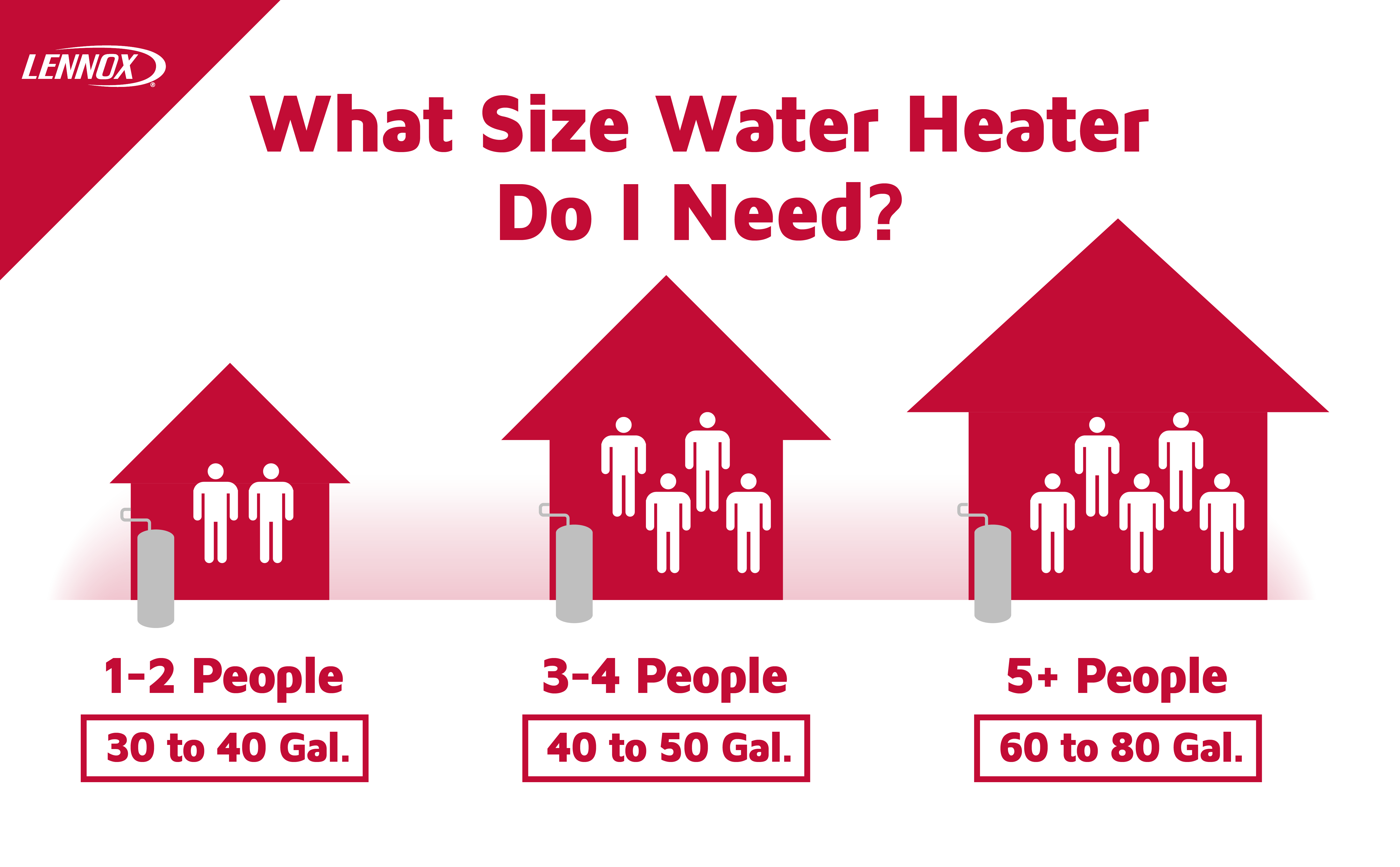
These are starting points, not final answers. Your actual usage habits can significantly shift these numbers. Keep in mind:
- Simultaneous use matters: Think about your family's morning routine. Do multiple people shower back-to-back? Is the dishwasher running while someone is in the shower? These overlapping demands require either a larger tank or a unit with a higher FHR to keep up.
- Where you live affects sizing, too: Your local groundwater temperature plays a bigger role than most people realize. In northern states, where incoming water might be around 45°F, your heater has to work much harder to reach 125°F than in southern regions, where groundwater starts closer to 70°F. That temperature gap can mean you need to size up by 10-20%.
Factors That Determine the Right Water Heater Size
A few factors can help make your water heater decision much easier:
- Number of people and their ages: Teenagers tend to use significantly more hot water than young kids. A family of four with two teenagers will likely need more capacity than a family of four with two toddlers, even though the headcount is the same.
- Hot water usage habits: Some households use around 40 gallons per person per day, while others use 80 gallons or more. For some context, 500 gallons of water would last one person roughly 6 to 12 days, depending on their habits. Long showers, frequent laundry, and daily dishwasher use all add up fast.
- Your appliances: Modern, energy-efficient dishwashers use only 4 to 6 gallons per cycle, while older models can use 10 or more. High-efficiency washing machines use less hot water overall, but if you run hot-water cycles frequently, demand still rises. Knowing what your appliances use helps you calculate the size of your water heater more accurately.
Tips for Choosing the Right Size Water Heater
Avoid these common mistakes:
- Do not size based solely on tank gallons. Always check the FHR and recovery rate.
- Do not size for average daily use. Size for your peak demand window, usually the morning rush.
- Do not ignore your climate. Colder incoming water means your unit has to work harder.
Think ahead: Consider what your household might look like in the next 5 to 10 years. Planning to add family members or remodel a bathroom? It can be more cost-effective to size slightly larger upfront than to replace a unit that becomes too small down the road. That said, avoid oversizing by more than 20% of your current needs, as that leads to unnecessary energy waste.
Bigger is not always less efficient: A larger tank running at partial capacity can actually be more efficient than a smaller tank running at full capacity all day. Modern water heaters with advanced insulation and smart controls make this even more true.
When to Consult a Professional for Water Heater Sizing
Some situations call for a professional's input:
- Complex installations: If you are switching from a tank to a heat pump system, upgrading your gas line, or working in tight installation spaces, an HVAC professional can ensure the job is done right and the unit is properly sized for your setup.
- Code, venting, and utility requirements: Local building codes, venting standards, and utility rebate programs can all influence which water heater size and type you can install. A professional knows these requirements and can help you choose a unit that meets local regulations while also qualifying for any available energy rebates or incentives. This is a detail that is easy to overlook but can save you real money.
- Long-term efficiency and reliability: A professional load calculation takes all of your home's variables into account, giving you a much more precise size recommendation than a general chart can. That accuracy pays off in lower energy bills and a longer equipment life.
The Bottom Line
Choosing the right water heater size comes down to knowing your household, your habits, and your home. Start with the general size guidelines, factor in your peak-demand times, check the FHR, and consider where you live.
Lennox offers water heater options for households of every size, so whether you are a couple in a small home or a large family with heavy hot water demands, there is a solution built for you. Getting the size right means reliable hot water every day, lower energy costs, and a system that lasts.
We’re here to help make home comfort solutions a little clearer and a lot less stressful.
No Worries. It’s a Lennox.™