
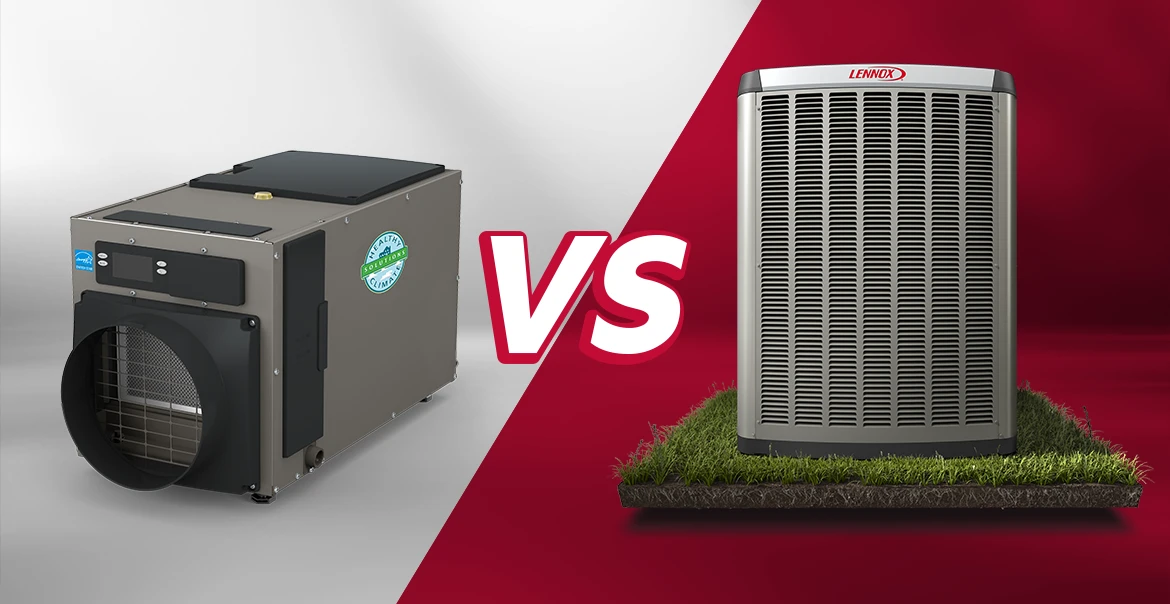
The Difference Between Dehumidifiers and Air Conditioners
When your home feels uncomfortable, it's easy to assume cranking the air conditioner is the solution. But sometimes the real problem isn't heat. It's humidity. That clammy, heavy feeling that lingers even when the thermostat reads 72 degrees? That's moisture in the air, and no amount of cooling can fully fix it on its own. Knowing the difference between a dehumidifier and an air conditioner, and choosing the right solution can keep you comfortable year-round while helping you manage energy use more efficiently.
What Is a Dehumidifier?
A dehumidifier has one clear job: pull excess moisture out of the air. It draws in warm, humid air, passes it over a cold coil where water vapor condenses and drips away, then returns drier air back into your living space at roughly the same temperature. No cooling. No refrigerant cycle powering your whole home. Just targeted moisture control. Since a whole-home dehumidifier integrates with your central cooling system, you avoid the noisy operation and constant bucket-emptying that comes with portable units.
A whole-home dehumidification system can remove up to 40 gallons of excess moisture daily, keeping indoor relative humidity in the ideal 40-60% range. Because dry air feels cooler, you can often raise your thermostat setting and still feel just as comfortable, which means potential energy savings without sacrificing comfort.
Pros and Cons of a Dehumidifier
Pros:
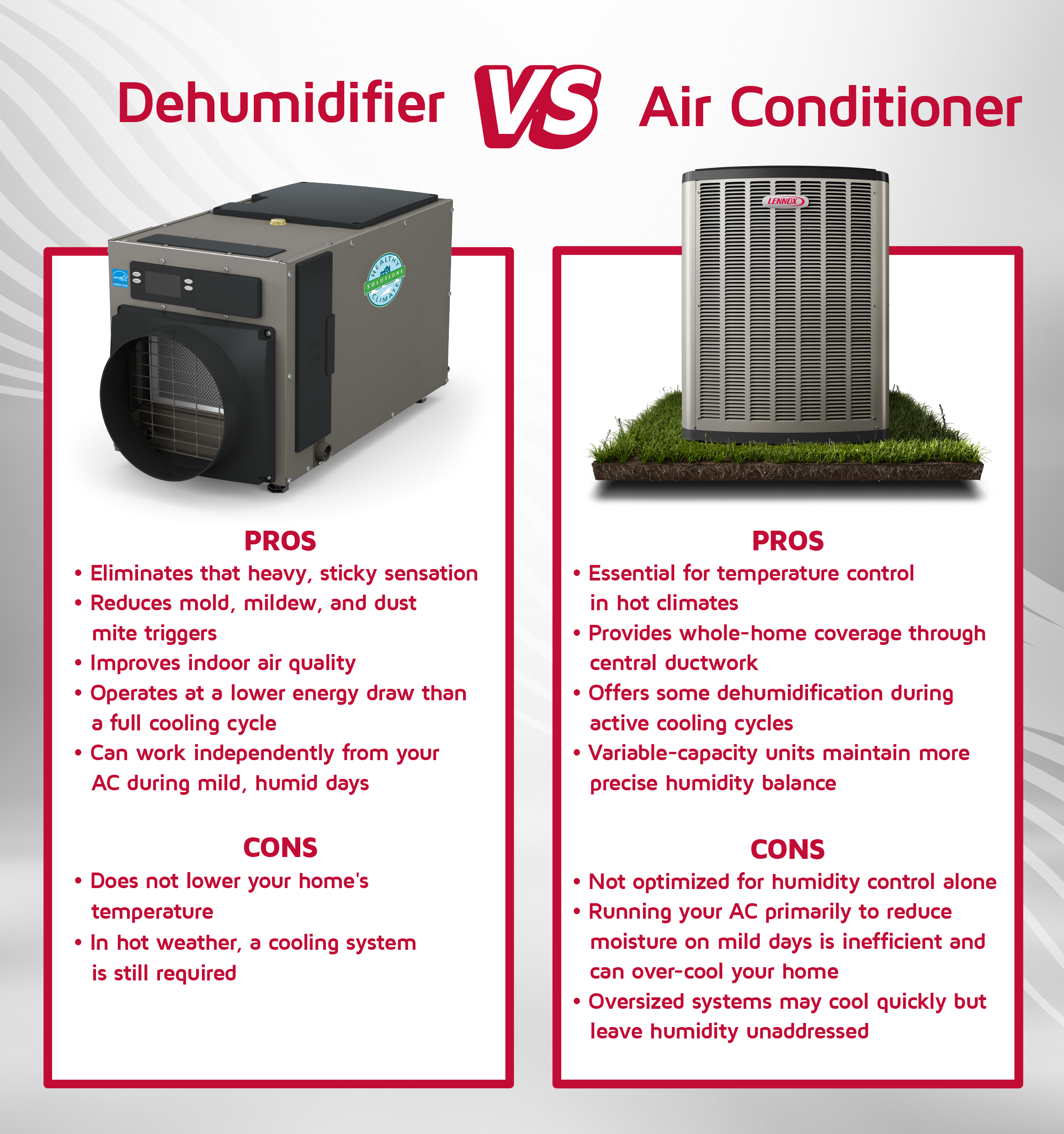
Eliminates that heavy, sticky sensation
Reduces mold, mildew, and dust mite triggers
Improves indoor air quality
Operates at a lower energy draw than a full cooling cycle
Can work independently from your AC during mild, humid days
Cons:
Does not lower your home's temperature
In hot weather, a cooling system is still required
What Is an Air Conditioner?
Your air conditioner moves heat out using the indoor unit, typically a furnace or air handler. It pulls warm air from inside your home across the evaporator coil, transfers that heat to the refrigerant, and releases it outside, leaving your interior cooler. The outdoor unit, also known as the condenser, releases that heat into the outside air, and the refrigerant cools back down. As a secondary benefit, some moisture condenses on the indoor coil during this process, giving your AC a partial dehumidifying effect. The cycle repeats continuously to maintain the comfortable temperature you've set on your thermostat.
Pros and Cons of an Air Conditioner
Pros:
Essential for temperature control in hot climates
Provides whole-home coverage through central ductwork
Offers some dehumidification during active cooling cycles
Variable-capacity units maintain more precise humidity balance
Cons:
Not optimized for humidity control alone
Running your AC primarily to reduce moisture on mild days is inefficient and can over-cool your home
Oversized systems may cool quickly but leave humidity unaddressed
Key Differences: Dehumidifier vs Air Conditioner
These two systems are built for different jobs, and understanding where they diverge makes it much easier to choose the right one for your home.
Primary Function: A dehumidifier's sole purpose is to pull excess moisture out of the air. An air conditioner's primary job is to lower the temperature inside your home by transferring heat outside.
Cooling Capability: A dehumidifier does not cool your home. It only addresses moisture. An air conditioner, on the other hand, is specifically designed to bring your indoor temperature down, making it essential during hot weather.
Humidity Removal: Dehumidifiers are purpose-built for moisture control and do it with precision. Air conditioners do remove some humidity, but that removal is inconsistent and depends heavily on how long and hard the system runs.
Energy Usage: Because a dehumidifier doesn't power a full refrigeration cycle the way a central AC does, it generally draws less energy during operation. If humidity is your main problem on a mild day, running a dehumidifier is far more efficient than cycling your entire cooling system.
Ideal Usage: A dehumidifier shines in high-humidity conditions, especially when temperatures are moderate and cooling isn't needed. An air conditioner is the right tool when both heat and humidity are present, or when temperature is the primary comfort issue.
Cost to Operate: Dehumidifiers typically cost less to run on a day-to-day basis than central air conditioners, making them a smart choice for homes where moisture is the recurring problem rather than heat.
When to Use a Dehumidifier?
In High-Humidity Climates
Some days, the heat isn't the issue. When outdoor humidity surges, whether during a particularly muggy stretch of summer, peak monsoon season, or a stretch of heavy rainfall, your air conditioner is fighting a battle it wasn't designed to win alone. Indoor relative humidity should stay between 40-60% for real comfort. Drift outside that range and you're looking at a higher likelihood of dust mites, airborne viruses, and respiratory irritants taking hold in your home. A whole-home dehumidifier steps in to manage moisture directly, keeping your indoor air balanced even when the weather outside has other plans.
In Basements and Crawl Spaces
Below-grade spaces are moisture magnets. Water works its way through concrete walls, airflow is minimal, and your central system often can't reach those areas with enough force to make a difference. A dedicated dehumidifier gives these spaces the focused attention they need, stopping dampness before it becomes a larger structural or health concern.
When Your Home Is Sending You Signals
Your home will tell you when humidity is the problem. Foggy windows, a musty smell that won't quit, or moisture collecting on your ductwork are all signs that your air conditioner is doing its best, but humidity still has the upper hand. At that point, targeted moisture control is the answer.
When to Use an Air Conditioner?
In Hot, Humid Climates
When both heat and moisture are relentless, your air conditioner is your first line of defense. It addresses the temperature side of the equation while providing some degree of humidity reduction as a secondary benefit. For homeowners in the South, Southeast, or anywhere with long, sweltering summers, a properly sized AC is non-negotiable. Pair it with a whole-home dehumidifier and you've addressed both variables completely.
When the Heat Is the Real Problem?
There's no substitute for a central air conditioner when temperatures climb. Cooling your home requires moving heat out, and that's exactly what your AC is engineered to do. It pulls warm air in, transfers the heat outside through a refrigerant cycle, and circulates cooler air back through your ductwork so every room stays consistently comfortable.
When You're Running a Full Household?
High-traffic rooms generate heat fast. More people, more activity, and more appliances all drive temperatures up. Your air conditioner handles that load, maintaining a steady, comfortable environment throughout the day without skipping a beat.
Can You Use a Dehumidifier and Air Conditioner Together?
Not only can you, but in many homes you should. Each system is built to do one thing exceptionally well, and when you combine them, the result is noticeably better than either one working alone. Your dehumidifier handles moisture control independently, so your air conditioner can run shorter, more efficient cycles focused purely on temperature. That means less wear on your equipment, lower energy consumption over time, and a home that genuinely feels comfortable rather than just cool. A whole-home dehumidifier integrated with your central HVAC system is the kind of setup that stops you from wondering why the air still feels heavy even with the AC running.
How to Choose the Right Option?
Based on Climate
Your geography drives a lot of this decision. Homeowners in dry, arid climates can often get by with a well-sized air conditioner alone. But if you're in a coastal region, the Southeast, the Midwest during storm season, or anywhere that sees prolonged periods of heavy humidity, adding a whole-home dehumidifier to your setup is a smart, long-term investment in your family's comfort.
Based on Room Size and Coverage
Portable dehumidifiers work for isolated spaces, but they require constant maintenance and only address one room at a time. Whole-home dehumidifiers are sized by how much air volume they can process and integrate directly with your existing HVAC system, giving you consistent moisture control across every room without the hassle. For larger homes especially, whole-home coverage is the only way to ensure no space gets left behind.
Based on Budget
If upfront cost is the primary concern, it's worth knowing that dehumidifiers generally cost less to operate on a daily basis than central air conditioners, because they don't run a full refrigeration cycle. If your main discomfort is humidity rather than heat, using a dehumidifier on mild days instead of cycling your AC is the more economical habit to build over time.
Based on Energy Efficiency Goals
For homeowners looking to reduce overall energy consumption, pairing a variable-capacity air conditioner with a whole-home dehumidifier is one of the most efficient approaches available. The AC runs only as hard as it needs to, and the dehumidifier handles moisture without requiring a full cooling cycle. Together, they reduce total system runtime and can meaningfully lower your energy use season over season. A local Lennox dealer can help map out the most efficient configuration for your home's specific layout and climate.
FAQ
Does an AC work as a dehumidifier?
Partially. Moisture does condense on the indoor coil during a cooling cycle, so your AC removes some humidity as it runs. But that's a byproduct, not the purpose. An oversized system cools your home quickly and shuts off before it has time to pull meaningful moisture from the air, leaving you with a space that's cool but still clammy. For real humidity control, a dedicated dehumidifier is the more reliable choice.
Do dehumidifiers cool rooms?
No, a dehumidifier does not lower the temperature in your home. What it does do is remove the moisture that makes heat feel more oppressive. Dry air simply feels more comfortable at the same temperature, so running a dehumidifier can make a real difference in how a space feels, even without any change to the thermostat.
Is a dehumidifier necessary if I already have AC?
In humid climates, it often is. Your AC provides incidental dehumidification while it's actively cooling, but it's not designed to maintain precise humidity levels on its own. A whole-home dehumidifier fills that gap, running independently when temperatures are moderate and your AC doesn't need to cycle on, keeping your home's air quality consistent year-round.
Can a dehumidifier replace an air conditioner?
No. These two systems solve different problems. A dehumidifier addresses moisture; an air conditioner addresses heat. In warm weather, you still need your AC to bring temperatures down to a comfortable level. The dehumidifier works alongside it, not in place of it.
Find Your Perfect Comfort Combination
The dehumidifier vs air conditioner question comes down to what's actually making you uncomfortable. If heat is the problem, your air conditioner is the answer. If humidity is the culprit, a dedicated dehumidifier is the more targeted and efficient fix. And if both are factors, combining the two with an integrated whole-home system delivers results you can feel in every room.
Not sure whether your home needs a dehumidifier, a more efficient AC, or both? A local Lennox dealer can walk through your home's specific needs, climate, and setup to recommend the right solution. Better air starts with the right plan.
We’re here to help make home comfort solutions a little clearer and a lot less stressful.
No Worries. It’s a Lennox.™