

Modern thermostats offer conveniences like remote control, learning capabilities, energy-saving features, and smart home integration. To support these functions, many models require something older thermostats did not: a continuous power source. That is what the thermostat C wire is for. Understanding what the C wire does, why some homes don’t have one, and what your options are if it’s missing can help you make the right decisions when upgrading or installing a new thermostat.
What Is the C Wire?
The C wire, short for “common wire,” provides continuous low-voltage power from your HVAC system to your thermostat. Older thermostats required only enough power to run simple on/off commands. Modern and smart thermostats rely on additional features such as digital displays, Wi-Fi connectivity, learning algorithms, sensors, and advanced scheduling. These “always-on” functions require a steady power supply.
The C wire works together with the R wire, which delivers 24-volt power. While the R wire supplies electricity, the C wire provides the return path for that current, creating a complete and continuous circuit. Without this constant flow, smart thermostats may lose connection, reboot frequently, or fail to perform certain functions.
Do All Homes Have a C Wire?
Not necessarily. Many older homes were built when mechanical thermostats were the norm. These units only required two to four wires. As a result, older HVAC systems may not include a dedicated C wire in the thermostat cable. You might also find that your system has a C wire at the control board, but the wire was never run up through the wall to the thermostat.
How to Check Whether You Have a C Wire?
Checking for a C wire is usually simple. First, always make sure you turn off power to your HVAC equipment before removing the thermostat faceplate.
- Look at the Thermostat Terminals
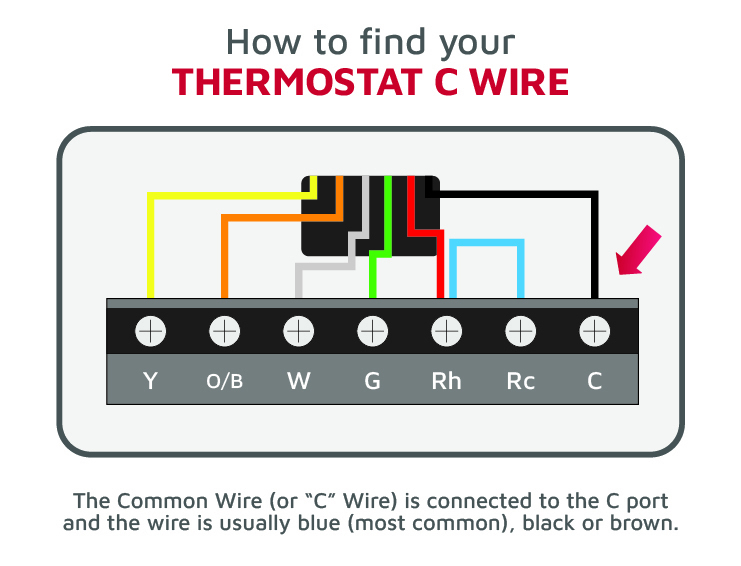
Remove the thermostat cover and look for a wire connected to a terminal labeled “C.”
Common C wire colors include:
- Blue (most common)
- Black
- Brown
However, wire colors are not always reliable. Some installers repurpose unused wires, so it is important to verify the terminal labeling.
- Check for Unused Wires
If no wire is connected to “C,” look behind the thermostat plate. Sometimes an unused wire is tucked into the wall and can be connected to the C terminal if it is connected properly at the furnace control board.
- Inspect the Furnace or Air Handler
The C terminal on the control board will show whether a C wire is available at the equipment. If you find a connected C wire at the furnace but not at the thermostat, a technician can often run or reconnect the wire through the wall.
Why the C Wire Matters for Smart Thermostats?
Smart thermostats draw more power than standard programmable models. A C wire ensures:
- Continuous Wi-Fi connectivity
- Accurate temperature readings 24/7
- Stable operation without rebooting
- Support for features like geofencing, learning schedules, voice assistant integration, and energy reports
Without a C wire, many smart thermostats rely on “power stealing,” a method where the thermostat pulls small amounts of power from the system’s control circuits. This can cause performance issues or interfere with HVAC operation.
What If Your Home Does Not Have a C Wire?
There are several solutions if your home lacks a C wire.
- Use an Unused Wire as a C Wire: If extra wires exist behind your thermostat and at the furnace board, a technician may repurpose one as the C wire. This is usually the simplest and cleanest solution.
- Install a C Wire Adapter: Some smart thermostats include or sell a power adapter that provides continuous power without installing new wiring. These adapters connect to the HVAC control board and thermostat to simulate a C wire.
- Have a New C Wire Installed: Running a new wire is the most reliable long-term solution. This should be done by an HVAC professional because it requires access to existing wiring pathways and proper connection at the control board.
Benefits of Having a C Wire Connected
Adding or using a proper C wire helps homeowners get the most out of their thermostat:
- More stable operation with fewer errors
- Energy reporting and scheduling features
- Consistent connectivity
- Improved long-term reliability
- Reduced strain on HVAC equipment, because the thermostat communicates more accurately and consistently
Smart thermostats are designed to help optimize energy usage through learning patterns and improving comfort control. A dependable power source is vital to support these features.
When to Contact a Professional?
If you are unsure which wire is which, don’t see an unused wire, or are hesitant to open the furnace cabinet, it is best to contact a qualified HVAC technician. They can safely troubleshoot your wiring, ensure compatibility with your system, and install new wiring if needed. This prevents connection errors that could damage your HVAC equipment or thermostat.
Understanding the purpose of the C wire allows homeowners to choose the right thermostat and ensure it performs at its highest potential. Whether you already have a C wire in place or need one added, this small but essential connection supports comfort, efficiency, and the modern features many thermostats offer today.