
Choosing the right air conditioner (AC) for your home isn't just about staying cool; it's about finding your personal comfort level while keeping energy bills in check. If you're shopping for a new cooling system, you've probably come across terms like "single-stage," "two-stage," and "variable-capacity." But what do these actually mean for you and your family? Let's break down your options so you can make the right choice for your home.
What is an AC Cooling Stage?
A cooling stage refers to how your air conditioner adjusts its output to match your home's cooling needs. It's all about control and flexibility. Think of it this way: not every day requires the same level of cooling. A mild spring afternoon needs different treatment than a scorching summer day. The cooling stage you choose affects everything from how comfortable you feel to what you pay each month on your energy bill.
A note on terminology: You might see "variable-speed" and "variable-capacity" used interchangeably when shopping for air conditioners. While the terms are technically different, variable-speed refers to how the blower motor operates, while variable-capacity describes how the compressor adjusts cooling output. In practice, they describe the same type of advanced system that continuously modulates to match your home's exact needs.
Exploring Single-Stage Air Conditioners
How Single-Stage AC Works
A single-stage air conditioner operates at one speed: full capacity. When your thermostat calls for cooling, the compressor kicks on and runs at 100% until your home reaches the set temperature. Then it shuts off completely. This cycle repeats throughout the day.
It's straightforward and gets the job done, but it's not the most refined approach to comfort.
When Single-Stage Makes Sense
If you're working with a tighter upfront budget, a single-stage system delivers reliable performance without the bells and whistles. With fewer components than other air conditioners, they offer easier maintenance and less cost to purchase and install.
The Trade-Offs
Here's what you're giving up: single-stage systems may cause temperature swings in your home. They blast cold air until the thermostat is satisfied, then shut down completely. This on-off cycling can leave some rooms feeling too cold while others stay warm.
They also run louder and use more energy because they're always at maximum capacity. Over time, this can add up on your utility bills.
Exploring Two-Stage Air Conditioners
How Two-Stage Systems Operate
A two-stage air conditioner offers two levels of cooling: a low setting (typically 60-70% capacity) and a high setting (100% capacity). On most days, the system runs on the lower setting, which is enough to keep your home comfortable. When temperatures spike, it shifts to high capacity to handle the extra demand.
This flexibility makes a real difference in how your home feels.
The Benefits of Two-Stage Cooling
Two-stage systems deliver more consistent temperatures throughout your home compared to single-stage systems. Because they run longer at lower capacity, they remove more humidity from the air, making your space feel more comfortable even at slightly higher temperatures.
They're also quieter than single-stage units when running on low. And because they're not constantly cycling on and off at full power, they use less energy, which translates to lower monthly bills.
Is a Two-Stage AC Worth It?
For most homeowners, yes. While two-stage air conditioners typically cost more upfront due to more complex components and installation, you'll see the payoff in comfort and energy savings.
If you live in an area with hot summers, have a larger home, or simply value consistent comfort, a two-stage system makes sense. The improved humidity control alone can transform how your home feels.
Exploring Variable-Capacity Air Conditioners
How Variable-Capacity Technology Works
Variable-capacity air conditioners represent the cutting edge of home cooling. Instead of one or two settings, these systems can adjust their output in tiny increments, sometimes as many as 700 different levels, to match your home's exact cooling needs at any moment.
They run almost continuously at very low speeds, making constant micro-adjustments to maintain perfect air quality and temperature.
The Comfort Advantage
Variable-capacity systems deliver the most precise temperature control available. They help significantly reduce hot and cold spots, providing more consistent, even cooling throughout your entire home. They're incredibly quiet, often running at noise levels barely above a whisper.
The humidity control is exceptional. Because these systems run longer at lower speeds, they pull more moisture from the air, which is especially valuable in humid climates.
Are Variable Speed Air Conditioners Worth the Extra Money?
Variable-capacity systems usually cost more upfront, but they're also the most energy-efficient option available, often reducing cooling costs compared to single-stage systems.
If you're planning to stay in your home long-term, prioritize comfort, or live in an area with high humidity and cooling demands, a variable-capacity system is worth considering. The energy savings accumulate year after year, and the comfort difference is noticeable from day one.
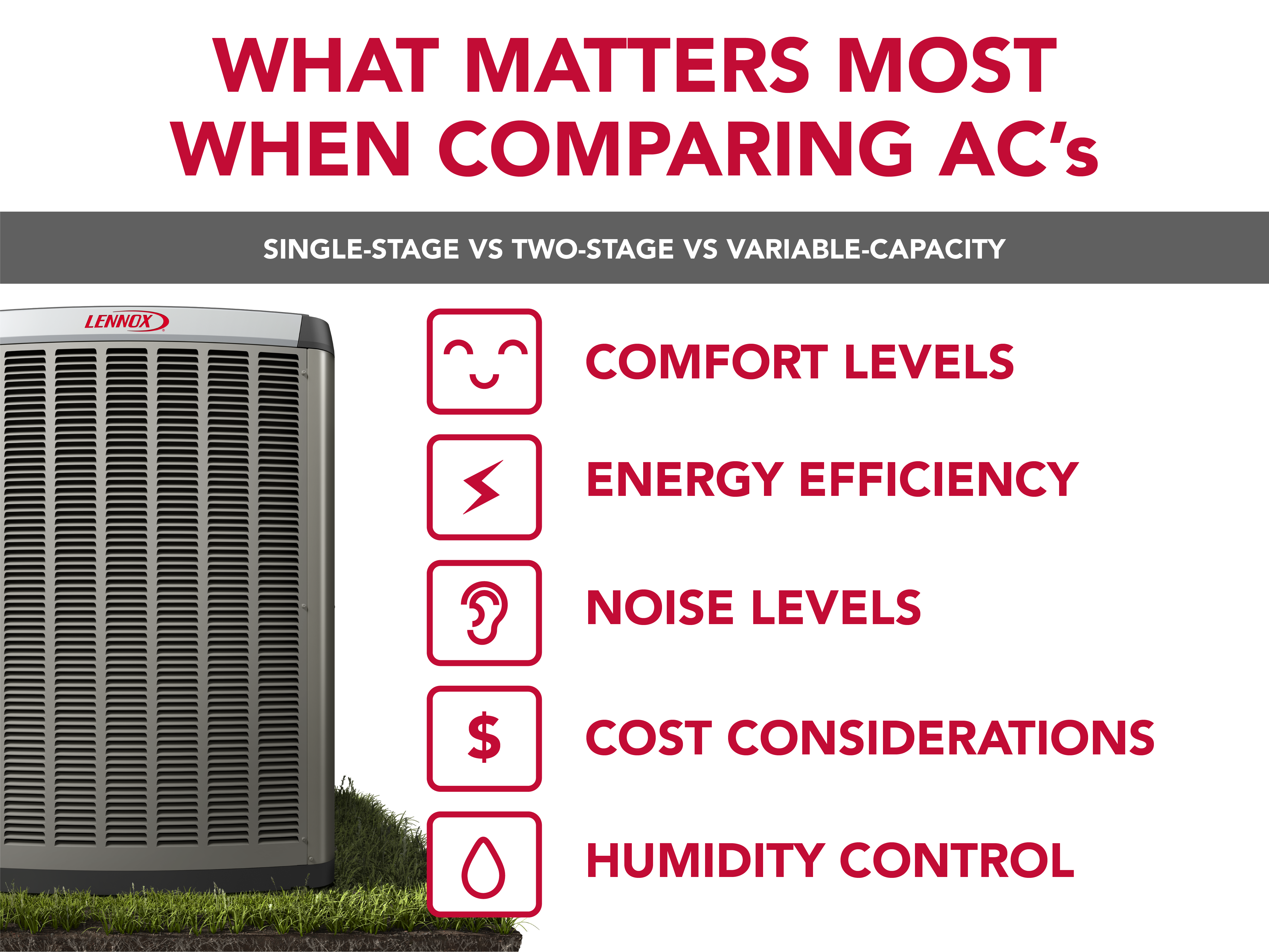
Comparing the Three Options: What Matters Most
Comfort Levels
Single-stage systems provide basic cooling with temperature fluctuations. Two-stage systems offer improved comfort with more consistent temperatures. Variable-capacity systems deliver the ultimate in comfort with precise, continuous control.
Energy Efficiency
Single-stage units are the least efficient, running at full capacity every time they operate. Two-stage systems improve efficiency by running at lower capacity most of the time. Variable-capacity systems are the most efficient, using only the energy needed at any given moment.
Noise Levels
Single-stage systems are the loudest when running. Two-stage systems are quieter at low speeds. Variable-capacity systems are the quietest overall, often barely audible when operating.
Cost Considerations
With more moving parts and greater temperature precision, two-stage systems usually cost more to purchase and install than single-stage systems. Variable-capacity systems can have an even higher upfront cost, but their efficiency helps offset this by lowering monthly energy bills.
Humidity Control
Single-stage systems provide basic dehumidification. Two-stage systems offer better humidity control by running longer cycles. Variable-capacity systems excel at removing humidity, creating a more comfortable indoor environment.
Making Your Decision: Which System is Right for You?
Consider Your Climate
If you live somewhere with mild summers and moderate cooling needs, a single-stage system might be enough. For areas with hot, humid summers, two-stage or variable-capacity systems make more sense.
Think About Your Home
The size and layout of your home play a crucial role in determining the appropriate air conditioner type. Larger homes benefit more from two-stage or variable-capacity systems because these units distribute cooling more evenly. Smaller homes or apartments may not need the advanced features of such systems.
Evaluate Your Budget
Look beyond the sticker price. A more expensive system that cuts your energy bills by 25% might actually cost less over its lifetime than a cheaper unit that runs inefficiently.
Prioritize What Matters
If consistent comfort and quiet operation matter most to you, invest in a two-stage or variable-capacity system. If you need reliable cooling at the lowest upfront cost, a single-stage system does the job.
Finding The AC That Fits You
The right air conditioner transforms your home into a place where you feel completely comfortable, no matter what's happening outside. Whether that means investing in a variable-capacity system with all the advanced features or choosing a straightforward single-stage unit that fits your budget, the best choice is the one that meets your specific needs.
Ready to find your next air conditioner? Connect with a Lennox dealer near you to explore your options and get a personalized recommendation for your home.
We’re here to help make home comfort solutions a little clearer and a lot less stressful.
No Worries. It’s a Lennox.™