
When it comes to indoor comfort, most homeowners focus on temperature. But comfort is about more than how warm or cool the air feels. Moisture in the air plays an equally important role. This is where the concepts of sensible heat and latent heat come into play. Understanding the difference between the two helps explain how HVAC systems manage both temperature and humidity to create a comfortable, efficient, and healthy home environment.
Air conditioners and heat pumps are designed to handle both forms of heat. When either one is out of balance, you may notice discomfort, higher energy bills, or indoor air quality issues.
What Is Sensible Heat?
Sensible heat refers to heat that causes a change in temperature without changing the physical state of a substance. It is the type of heat you can feel and measure with a thermometer.
When your thermostat reads that the indoor temperature has dropped from 78°F to 72°F, that change is the result of sensible heat being removed from the air. Heating systems add sensible heat to raise indoor temperatures, while air conditioners remove sensible heat to lower them.
Sensible heat is measured using temperature readings. In HVAC systems, sensors and thermostats track air temperature to determine when heating or cooling is needed.
Everyday examples of sensible heat include:
- Warm air coming from a heating vent in winter
- Cool air blowing from supply vents during summer
- Heat felt from sunlight streaming through a window
In an HVAC system, sensible heat control determines how hot or cold the air feels inside your home.
What Is Latent Heat?
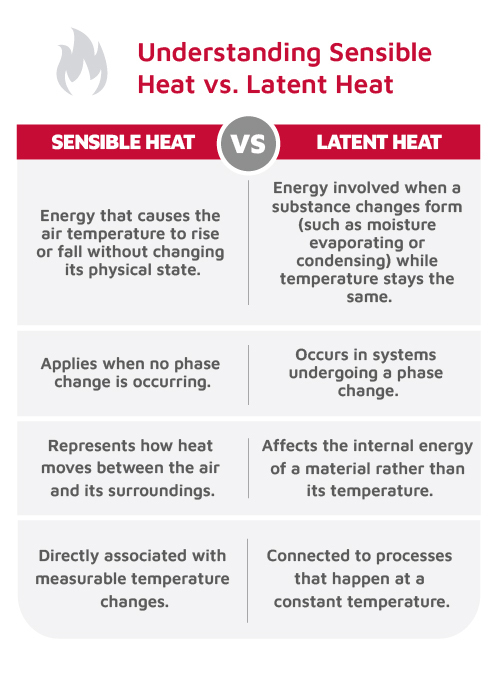
Latent heat works differently. Instead of changing temperature, latent heat involves moisture and phase changes. It is the heat absorbed or released when a substance changes state, such as from liquid to vapor or vapor to liquid, without changing temperature.
In a home, latent heat is most closely tied to humidity. When water evaporates into the air, it absorbs latent heat. When water vapor condenses back into liquid, it releases latent heat.
Air conditioners remove latent heat during the dehumidification process. As warm, humid air passes over the cold evaporator coil, moisture condenses into liquid water and drains away. This process removes water vapor from the air, lowering humidity levels while releasing latent heat inside the system.
Common examples of latent heat include:
- Steam rising from a hot shower
- Condensation forming on a cold glass
- Moisture being removed by an air conditioner
Latent heat control is essential for managing indoor humidity and preventing issues like mold growth, musty odors, and discomfort.
Sensible Heat vs. Latent Heat: Key Differences
The main difference between sensible heat and latent heat lies in what they affect. Sensible heat changes temperature. Latent heat changes moisture levels.
An HVAC system must manage both at the same time. Cooling the air without removing enough moisture can leave a home feeling cold and clammy. Removing moisture without adequate temperature control can still result in discomfort.
This balance is often described using the sensible heat ratio (SHR), which represents how much of the cooling capacity goes toward temperature reduction versus moisture removal. Different homes and climates require different balances.
In humid climates, HVAC systems need to remove more latent heat. In dry climates, sensible heat control becomes more dominant. Well-designed systems are sized and configured to handle both demands efficiently.
Why Both Types of Heat Matter for Comfort?
True comfort is achieved when temperature and humidity work together. High humidity can make warm air feel hotter and cool air feel sticky. Low humidity can cause dry skin, irritation, and static electricity.
By removing sensible heat, your air conditioner lowers indoor temperatures. By removing latent heat, it reduces excess moisture. Together, these processes create a space that feels comfortable, not just cool.
Balanced sensible and latent heat control also improves indoor air quality. Lower humidity discourages mold, mildew, and dust mites. Stable temperatures help prevent condensation on surfaces, which can lead to moisture damage over time.
How HVAC Systems Manage Sensible and Latent Heat?
Modern HVAC systems are designed to handle both forms of heat through proper sizing, airflow, and system operation. To manage both sensible and latent heat effectively, you can focus on a few practical strategies:
- Use programmable thermostats.These devices help regulate temperature and humidity by adjusting HVAC operation based on daily schedules and occupancy. Longer, more consistent run times can improve moisture removal while maintaining comfortable temperatures.
- Prioritize regular system maintenance.Routine service keeps coils, filters, and internal components clean, so heat transfer remains efficient. Clean evaporator coils and unobstructed airflow are essential for removing both heat and moisture effectively.
- Ensure proper system sizing and efficiency.An HVAC system that is correctly sized for the home’s cooling and moisture load is better equipped to balance temperature control and dehumidification. Modern, energy-efficient systems are designed to manage sensible and latent heat together, reducing energy use while improving comfort.
Why Understanding the Difference Matters?
Better understanding sensible and latent heat means you are better equipped to recognize comfort issues. If your home feels cool but damp, or dry but unevenly heated, the issue may not be temperature alone. It may be how moisture is being managed.
Both sensible and latent heat are essential parts of HVAC performance. When they are properly balanced, your system delivers consistent comfort, efficient operation, and healthier indoor air.
By understanding how these two forms of heat work together, you gain clearer insight into how their HVAC systems support comfort year-round and why temperature alone does not tell the full story.